Microgravity Quiz #1
Free-Fall Physics
To graduate
from Space Sciences Academy, you must answer the following questions correctly.
When you think all of your answers are correct, click on "Check my
answers" at the bottom of the quiz to see if you pass. Answer all the
questions correctly and you will qualify as an honorary member of the Space
Sciences Laboratory team. You will then be asked to write your name to be
put on your down-loaded award certificate. Good Luck!
What
is the shape of the paths satellites follow when in orbit above Earth?
Circular
Elliptical
Straight Line
Square
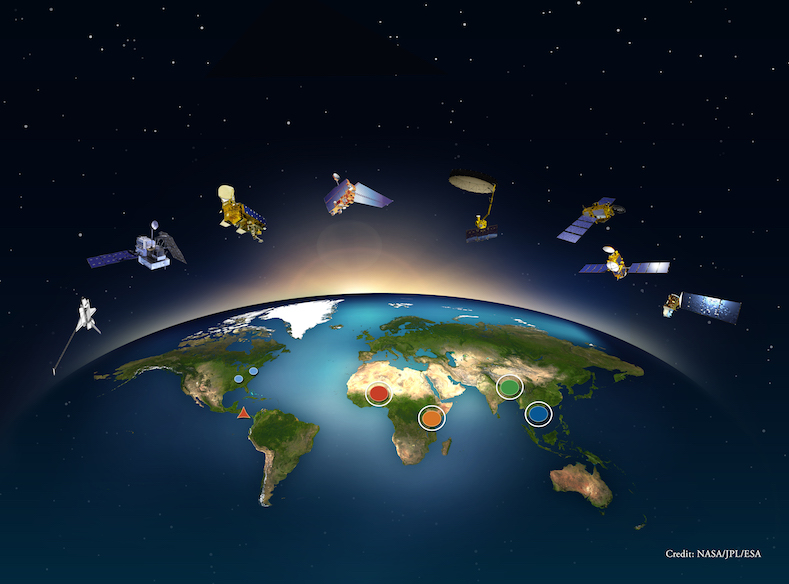
Confused? Read about satellites' behavior
in orbit.
Why doesn't a satellite in orbit strike Earth?
It's beyond the reach of Earth's gravity.
In space, objects
don't weigh anything.
The effect of the
moon's gravity pulls it away.
Earth's gravity is
balanced by the satellite's outward motion.
Don't know? Read more about satellites'
behavior in orbit
What causes a satellite to return to Earth?
The
United States Army
Mutual gravitational attraction
The object's inertia
Pure chance
Uncertain? See Around the World.
What is microgravity?
A
gravitational force too small to be measured
A gravitational force
which is 10-6 the effect at Earth's surface
Tiny bits of gravity
kept under glass at the National Institute of Standards and Technology
in Washington, D.C.
A gravitational force
which is 10-3 the effect at Earth's surface
Frustrated? Find it in Free Fall and Microgravity.
In experiment #2, replace the rubber bands with strings. If the frame is now
dropped, and before it hits the ground, what happens to the balloon?
The
balloon will be stressed
The balloon will burst
The balloon will not
burst
Impossible to predict
Curious? Look at the Free Fall Demonstrator with
ballons.
|